Thirukudanthai
Thirukudanthai is a Hindu temple where the presiding deities are Komalavalli and Aravamuda Perumal, located in Kumbakonam, Thanjavur district, Tamil Nadu. It is temple #12 in the traditional order of the 108 Divya Desams — the 108 Vishnu shrines praised in the Naalayira Divya Prabandham of the Alvar saints.
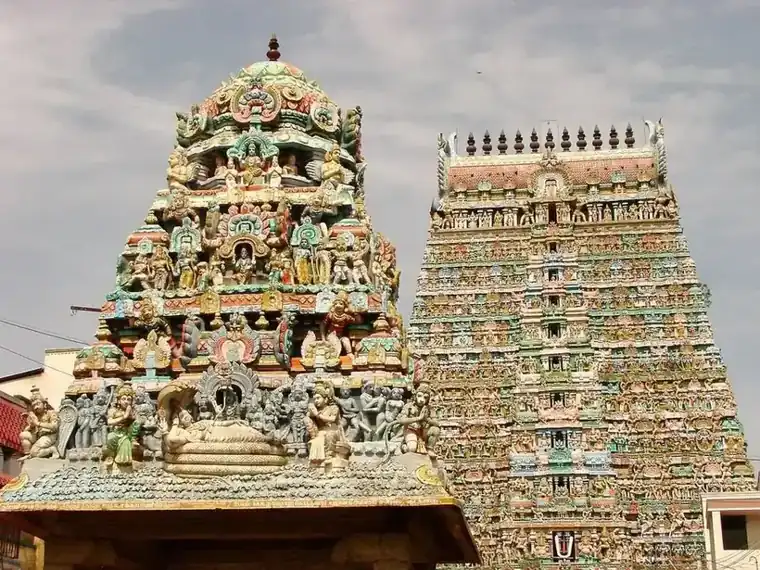
Kumbakonam's largest Vishnu temple, its soaring east gopuram one of the tallest in the Kaveri delta, enshrines Vishnu as Sarangapani emerging on a celestial chariot. It ranks among the foremost Divya Desams after Srirangam and Tirupati.
About Thirukudanthai
The Sharngapani Temple, also known as Thirukudanthai or Kumbakonam koyil, is a Hindu temple dedicated to Vishnu, located in Kumbakonam, Tamil Nadu, India. It is one of the Divya Desams, the 108 temples of Vishnu revered in Nalayira Divya Prabandham by the 12 poet-saints, or Alvars. Situated along the Kaveri river, it is counted among the Pancharanga Kshetrams.
Legend
As per Hindu legend, the Vaishnava deity, Sharngapani, an incarnation of the Hindu god Vishnu, appeared for a sage Hemarishi, who performed penance in the bank of Potramarai tank. Sage Bhrigu wanted To decide who was the supreme amongst the trimurthis- Brahma, Vishnu, Shiva. Having been to Brahma who ignored him, going to Shiva who did not notice him and finally Lord Narayana. Lord Narayana knew very well he was coming. Once, sage Bhrigu wanted to meet Vishnu at his residence, the Ocean of Milk. The sage did not get the attention of Vishnu who notices him but deliberately ignored him. In his anger, he kicked Vishnu on his chest.
History
The site of the Sharngapani Temple may have been a Vaishnava settlement as early as the 7th or 8th century. Oral traditions dating to the early Chola period reference the temple. The earliest epigraphical evidence of the temple dates to the late Chola period (10th-12th centuries). The temple became significant under the Vijayanagara and Nayaka rulers (15-17th centuries), who expanded its structure; their patronage represented a shift from the Cholas' interest in sponsoring Shaivite temples in Kumbakonam. The temple was one of the three main Vaishnava temples of Kumbakonam in this period, the others being the newer Ramaswamy Temple and Chakrapani Temple.
The Mahasamprokshanam also known as kumbhabhishekam of the temple was held on 13 July 2015. A large number of devotees took part in the Mahasamprokshanam.
Architecture and layout
Sharngapani is the largest Vishnu temple in Kumbakonam and has the tallest temple tower in the town. The temple is enshrined within a huge wall and the complex enshrines all the water bodies of the temple except the Potramarai tank. The rajagopuram (the main gateway) has eleven tiers and has a height of 173 ft (53 m). There are five other smaller gopurams in the temple. The rajagopuram has figures depicting various religious stories. The temple faces east and the Potramarai tank is located outside the western entrance.
In Bharatanatyam, a South Indian dance form, 108 karanas form the basic movements. Some of these karanas are sculpted around the walls of the temple. Similar sculptures are found in the Brihadeeswarar Temple in Thanjavur and Nataraja Temple in Chidambaram.
Festivals and worship
The temple follows Pancharatra Agama and Vadakalai tradition. It has remained as a stronghold for the Vadakalai tradition. The temple priests perform the puja (rituals) during festivals and on a daily basis. Like other Vishnu temples of Tamil Nadu, the priests belong to the Brahmin Vaishnavite sect, which is dedicated to Vishnu. The temple rituals are performed six times a day; Tiruvanandal at 8:00 a.m., Kala santhi at 9:00 a.m., Uchikalam at 12:30 p.m., Ntiyanusandhanam at 6:00 p.m., Irandamkalam at 7:30 p.m. and Ardha Jamam at 9:00 p.m. Each ritual comprises three steps: alangaram (decoration), neivethanam (food offering) and deepa aradanai (waving of lamps) for both Sharngapani and Thayar.
Akshaya Tritiyai - 12 Garuda Sevai Chaitra Brahma Utsavam celebrated during the Tamil month of Chittirai (April - May), Vasantotsavam during Vaikasi (May - June), Pavitrotsavam - Ekadasi Jyeshotsavam during Adi(July - August), Sri Jayanthi - Uriyadi Utsavam during Avani (August - September), Navaratri Utsavam - Saraswathi Puja - Vijayadasami during Purattasi (September - October), Deepavali - Shraddha of Sri Lakshmi Narayanaswami during Aippasi (October - November), Deepa Utsavam - Unjal Utsavam during Karthigai (November - December), Pakal Pattu - Ira Pattu Pongal Sankaramana Utsavam during Margazhi (December - January), Kanu Utsavam - Amavasya - Ratha Saptami during Thai (January - February), Masi Magaham - Float Festival during Masi (February…
Background adapted from Wikipedia, “Sarangapani Temple”, available under CC BY-SA 4.0. Edited for length; verify details locally.
Plan your visit
How to reach
Thirukudanthai is roughly 255 km from Chennai, about 6.5 h by road. The nearest airport is Tiruchirappalli (TRZ), about 76 km away. Open directions in Google Maps →
Timings: like most Tamil Nadu temples, expect an early-morning opening around 6 am, a midday closure from roughly noon to 4 pm, and evening darshan until about 8–9 pm. Festival days change everything, so confirm locally.
Today at a glance
Chennai time (IST), from our own panchangam. Nalla Neram is the good window; avoid Rahu Kalam and Yamagandam for starting a journey or a ritual.
Festival days to plan around
- Vaikunta Ekadasi — December–January
- Krishna Jayanthi — August–September
- Sri Rama Navami — March–April
- Purattasi Saturdays — September–October
Exact dates move with the lunar calendar every year; the festival calendar lists them to 2031, and the daily panchangam shows the tithi and nakshatra for any date.
Booking.com links are affiliate links; prices are the same for you and they help keep this guide free. Day tours: temple & heritage tours from Kumbakonam.
Quick facts
| Deity | Komalavalli and Aravamuda Perumal |
| Town | Kumbakonam |
| District | Thanjavur district |
| State | Tamil Nadu |
| Sacred lists | 108 Divya Desams |
| Divya Desam # | 12 |
Visiting
Most temples in Tamil Nadu open early morning and again in the evening, closing through the midday hours — plan darshan before noon or after 4pm and confirm timings locally, since festival days change everything. Dress modestly (shoulders and knees covered), leave footwear at the stands provided, and note that some sanctums admit Hindus only while towers and outer courtyards welcome everyone. Photography rules vary; ask before shooting inside.
Timing a visit? Check today’s panchangam for auspicious windows and festival days, and use our free itinerary builder to slot temples, food and rest into your day.
Temples near Kumbakonam
More Divya Desam temples
Frequently asked
How far is Thirukudanthai from Chennai?
About 255 km, or about 6.5 h by road. The nearest airport is Tiruchirappalli (TRZ), roughly 76 km from the temple.
What are the timings at Thirukudanthai?
Most Tamil Nadu temples open around 6 am, close from about noon to 4 pm, and reopen until 8–9 pm. Festival days follow a different schedule, so confirm locally before you travel.
What should I wear?
Dress modestly with shoulders and knees covered. Footwear is left outside at the stands provided. Some inner sanctums admit Hindus only, while towers and outer courtyards welcome everyone.
When is the best time to visit Thirukudanthai?
The temple is busiest and most atmospheric on its festival days: Vaikunta Ekadasi, Krishna Jayanthi, Sri Rama Navami. For a quiet darshan, come on a weekday morning outside festival season. Check the daily panchangam for Rahu Kalam before setting out.