Jambukeswarar Temple
Jambukeswarar Temple is a Hindu temple dedicated to Lord Shiva, located in Thiruvanaikaval, Tiruchirappalli district, Tamil Nadu. It is one of the 275 Paadal Petra Sthalams — the Shiva temples glorified in the Tevaram hymns of the Nayanmar saints.
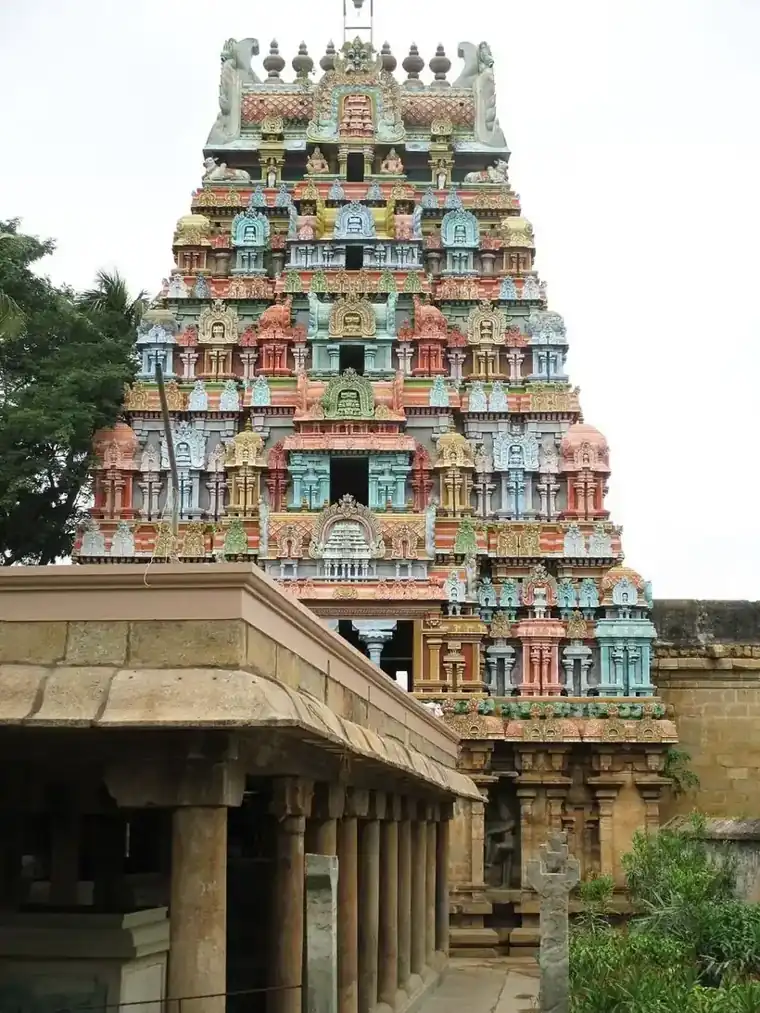
Thiruvanaikaval near Srirangam represents water among the Pancha Bhoota Sthalams — a spring in the sanctum keeps the Shiva lingam perpetually bathed. The goddess here is worshipped as a disciple of Shiva, and the noon ritual re-enacts that unique relationship.
About Jambukeswarar Temple
Jambukeswarar Temple, Thiruvanaikaval (also Thiruvanaikal, Jambukeswaram) is a temple of Shiva in Tiruchirapalli district, in the state of Tamil Nadu, India. It is one of the five major Shiva Temples of Tamil Nadu representing the Mahābhūta or five elements; this temple represents the element of water, or neer in Tamil. The sanctum of Jambukeswara has an underground stream. In the temple, Shiva is worshipped as Jambukeshwarar and his consort Parvati as Akilandeswari.
Legend
Once Parvati mocked Shiva's penance for betterment of the world. Shiva wanted to condemn her act and directed her to go to the earth from Kailasa (Shiva's abode) to do penance. Parvathi in the form of Akilandeswari as per Shiva's wish found Jambu forest (Thiruvanaikoil) to conduct her penance. She made a lingam out of water of river Cauvery (also called as river Ponni) under the Venn Naaval tree (the Venn Naaval tree on top of the saint Jambu) and commenced her worship. The lingam is known as Appu Lingam (Water Lingam). Siva at last gave darshan to Akilandeswari and taught her Siva Gnana.
There were two Shivaganas (Shiva's army who live in Kailash): 'Malyavan' and 'Pushpadanta'. Though they are Siva Ganas they always quarrel with each other and fight for one thing or other. In one fight 'Malyavan' cursed 'Pushpadanta' to become an elephant on earth and the latter cursed the former to become a spider on earth. The elephant and the spider came to Thiruvanaikaval and continued their Siva worship. The elephant collected water from river Cauvery and conducted ablution to the lingam under the Jambu tree (Eugenia jambolana, the java plum tree) daily.
Architecture and layout
The massive outer wall covering the fifth precinct, known as the Vibudi Prakara, stretches over 1.6 kilometres (1 mi) and is 0.61 metres (2 ft) thick and over 7.6 metres (25 ft) high. Legend maintains that the wall was built by Shiva himself, disguised as a laborer and working with the human laborers. The fourth precinct contains a hall with 796 pillars and measures 742 metres (2,436 ft) by 455 metres (1,493 ft). It also has a small tank fed by perpetual springs. The third enclosure is 227 metres (745 ft) by 60 metres (197 ft) surrounded a wall 9.1 metres (30 ft) high.
The sanctum sanctorum is a square structure, found independently situated at the center of the innermost enclosure. There is a vimana on the roof of the sanctum. The structure is open on three sides, with a shallow moat separating it from the circumambulatory path of the innermost enclosure. The sthala-vriksham, or holy tree here is the White Jambuka (Tamil: வெண் நாவல் மரம்) (Syzygium cumini), found growing along the south-eastern wall of the sanctum sanctorum. The trunk of the tree is protected by a walled structure.
Why it matters
Pancha Bhoota Sthalam (Sanskrit: पञ्चभूतस्थलानि Pañcabhūtasthalāni) refers to the five Shiva temples, each representing the manifestation of the five prime elements of nature - space, air, fire, water, earth. Pancha indicates five, Bhoota means elements and Sthala means place. All these temples are located in South India with four of these temples at Tamil Nadu and one at Andhra Pradesh. The five elements are believed to be enshrined in the five lingams and each of the lingams representing Shiva in the temple have five different names based on the elements they represent. In the Thiruvaanaikaval temple, Shiva is said to have manifested himself in the form of water (Appu Lingam).
Background adapted from Wikipedia, “Jambukeswarar Temple, Thiruvanaikaval”, available under CC BY-SA 4.0. Edited for length; verify details locally.
Plan your visit
How to reach
Jambukeswarar Temple is roughly 301 km from Chennai, about 8 h by road. The nearest airport is Tiruchirappalli (TRZ), about 10 km away. Most visitors base themselves in Tiruchirappalli, which has the rail links and hotels, and make this a day trip. Open directions in Google Maps →
Timings: like most Tamil Nadu temples, expect an early-morning opening around 6 am, a midday closure from roughly noon to 4 pm, and evening darshan until about 8–9 pm. Festival days change everything, so confirm locally.
Today at a glance
Chennai time (IST), from our own panchangam. Nalla Neram is the good window; avoid Rahu Kalam and Yamagandam for starting a journey or a ritual.
Festival days to plan around
- Maha Shivaratri — February–March
- Pradosham — twice a month, evening
- Arudra Darshan — December–January
- Karthigai Deepam — November–December
Exact dates move with the lunar calendar every year; the festival calendar lists them to 2031, and the daily panchangam shows the tithi and nakshatra for any date.
Booking.com links are affiliate links; prices are the same for you and they help keep this guide free. Day tours: temple & heritage tours from Tiruchirappalli.
Quick facts
| Deity | Shiva |
| Town | Thiruvanaikaval |
| District | Tiruchirappalli district |
| State | Tamil Nadu |
| Sacred lists | Paadal Petra Sthalams |
Visiting
Most temples in Tamil Nadu open early morning and again in the evening, closing through the midday hours — plan darshan before noon or after 4pm and confirm timings locally, since festival days change everything. Dress modestly (shoulders and knees covered), leave footwear at the stands provided, and note that some sanctums admit Hindus only while towers and outer courtyards welcome everyone. Photography rules vary; ask before shooting inside.
Timing a visit? Check today’s panchangam for auspicious windows and festival days, and use our free itinerary builder to slot temples, food and rest into your day.
Temples near Thiruvanaikaval
More Paadal Petra Sthalam temples
Frequently asked
How far is Jambukeswarar Temple from Chennai?
About 301 km, or about 8 h by road. The nearest airport is Tiruchirappalli (TRZ), roughly 10 km from the temple.
What are the timings at Jambukeswarar Temple?
Most Tamil Nadu temples open around 6 am, close from about noon to 4 pm, and reopen until 8–9 pm. Festival days follow a different schedule, so confirm locally before you travel.
What should I wear?
Dress modestly with shoulders and knees covered. Footwear is left outside at the stands provided. Some inner sanctums admit Hindus only, while towers and outer courtyards welcome everyone.
When is the best time to visit Jambukeswarar Temple?
The temple is busiest and most atmospheric on its festival days: Maha Shivaratri, Pradosham, Arudra Darshan. For a quiet darshan, come on a weekday morning outside festival season. Check the daily panchangam for Rahu Kalam before setting out.