Arunachalesvara Temple
Arunachalesvara Temple is a Hindu temple dedicated to Lord Shiva, located in Tiruvannamalai, Tamil Nadu. It is one of the 275 Paadal Petra Sthalams — the Shiva temples glorified in the Tevaram hymns of the Nayanmar saints.
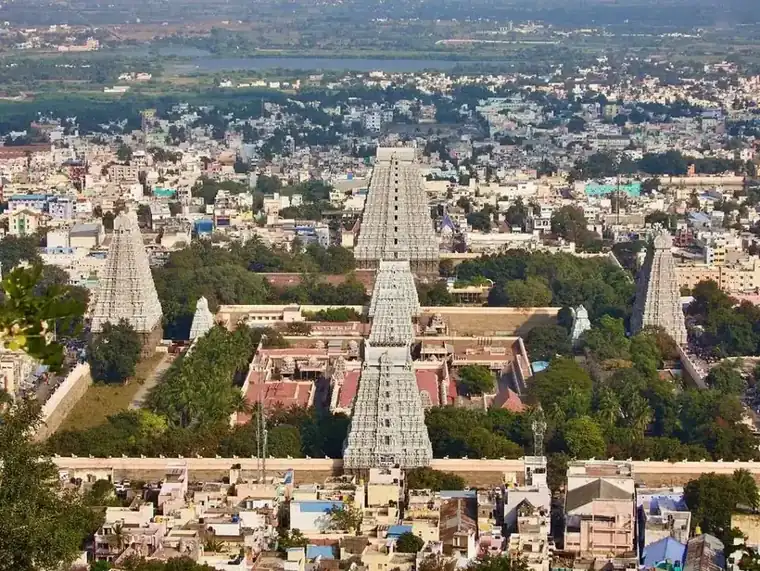
Tiruvannamalai's vast temple sits beneath the sacred hill of Arunachala, worshipped as Shiva in the form of fire — one of the Pancha Bhoota Sthalams. Every full moon, hundreds of thousands walk the 14-kilometre Girivalam path around the hill, and the Karthigai Deepam beacon lit on its summit is visible for miles.
About Arunachalesvara Temple
The Arunachalesvara Temple or Annamalaiyar Temple, is a Hindu temple dedicated to Shiva and Parvati, located at the foothills of the Arunachala hill in Tiruvannamalai, Tamil Nadu, India. It is regarded as one of the significant temples in the Tamil Shaivite tradition. It is one of the Pancha Bhuta Sthalams and is associated with the element of fire (Agni) among the five natural elements.
Legend
According to the Shiva Purana, Brahma (god of creation) and Vishnu (god of preservation) had an argument over their supremacy. To settle the debate, Shiva took the form of jyotirlinga, a huge column of fire or light, stretching across the three worlds. Vishnu took the form of a boar and descended to locate the bottom of the column, while Brahma assumed the form of a swan to locate its top. Vishnu failed in his search and returned, honest about the outcome of his quest. Brahma chanced upon a thalampu flower in the midst of his ascent.
According to Hindu mythology, Parvati once blindfolded Shiva, which led to the entire Earth being plunged in darkness. Shiva opened his third eye to shine light on the Earth. Realising her mistake, Parvati prayed for Shiva's forgiveness. Shiva directed her to go to Tiruvannamali and perform tapas at the ashram of sage Gautama. When Mahisasura disturbed her, she took the form of Durga, and killed the asura. Later, Shiva accepted her on the purnima day of the Tamil month of Karthigai. The Karthika Deepam festival is celebrated to commemorate the manifestation of Shiva as jyotirlinga, and his re-acceptance of Parvati.
History
The deities are described in the Shaiva text of Tevaram from the 7th century CE. Sekkilhar, the author of the Periya Puranam, wrote that Appar and Sambandar worshipped Annamalaiyar in the temple. The present masonry of the temple dates back to the 9th century to the reign of the Cholas. Inscriptions found in the temple record gifts such as land, and cows given to the temple by various Chola kings. Further inscriptions from the temple indicate that before the 9th century CE, the region was under the reign of the Pallava Kings, who ruled from Kanchipuram. The Hoysalas made the region around the temple as their capital in 1328 CE.
The temple was located at a strategic location in the Vijayanagara Empire, connecting important pilgrimage centers and military routes. Inscriptions describe the expansion of the temple, and the town developing around the Annamalaiyar temple during the period. There are 48 inscriptions from the Sangama Dynasty (1336–1485 CE), two inscriptions from the Saluva Dynasty, and 55 inscriptions from the Tuluva Dynasty (1491–1570 CE) of the Vijayanagara Empire, describing various gifts to the temple by their respective rulers. Inscriptions from the period of Krishnadevaraya (1509–1529 CE), indicates patronage to the temple. Most of the Vijayanagara inscriptions are written in Tamil, with some in Kannada and Sanskrit.
Architecture and layout
The temple is situated at the foot of the Annamalai hills, spread over 25 acres (10 ha). The walls on the east and west measure 700 ft (210 m) in length, the south 1,479 ft (451 m), and the north 1,590 ft (480 m). It has gopurams (ornamental gateway towers), one on each side. The eastern tower, known as the Rajagopuram, is the tallest, and largest with a base measuring 135 ft (41 m) by 98 ft (30 m). The south tower is called Thirumanchangopuram, the west tower as Pe Gopuram, and the north tower as Ammani Amman gourami.
The main shrine, holding the lingam of Annamalaiyar, faces east. It is considered the oldest structures within the temple complex, and houses the images of Nandi, Shiva's vahana and Surya, the Sun god. On the backside of the sanctum walls, there is an image of Venugopalaswamy (a form of Krishna, an incarnation of Vishnu). Surrounding the sanctum are images of various Hindu deities, including Somakanthar, Durga, Chandeshvara, Gajalakshmi, Arumugaswami, and Dakshinamurti, Bhairava, Nataraja, and Lingodbhava. The palliyarai, the divine room for resting deities, is located at the first precinct around the sanctum.
Background adapted from Wikipedia, “Arunachalesvara Temple”, available under CC BY-SA 4.0. Edited for length; verify details locally.
Plan your visit
How to reach
Arunachalesvara Temple is roughly 161 km from Chennai, about 4 h by road. The nearest airport is Puducherry (PNY), about 86 km away. Open directions in Google Maps →
Timings: like most Tamil Nadu temples, expect an early-morning opening around 6 am, a midday closure from roughly noon to 4 pm, and evening darshan until about 8–9 pm. Festival days change everything, so confirm locally.
Today at a glance
Chennai time (IST), from our own panchangam. Nalla Neram is the good window; avoid Rahu Kalam and Yamagandam for starting a journey or a ritual.
Festival days to plan around
- Maha Shivaratri — February–March
- Pradosham — twice a month, evening
- Arudra Darshan — December–January
- Karthigai Deepam — November–December
Exact dates move with the lunar calendar every year; the festival calendar lists them to 2031, and the daily panchangam shows the tithi and nakshatra for any date.
Booking.com links are affiliate links; prices are the same for you and they help keep this guide free. Day tours: temple & heritage tours from Tiruvannamalai.
Quick facts
| Deity | Shiva |
| Town | Tiruvannamalai |
| District | Tiruvannamalai district |
| State | Tamil Nadu |
| Sacred lists | Paadal Petra Sthalams |
Visiting
Most temples in Tamil Nadu open early morning and again in the evening, closing through the midday hours — plan darshan before noon or after 4pm and confirm timings locally, since festival days change everything. Dress modestly (shoulders and knees covered), leave footwear at the stands provided, and note that some sanctums admit Hindus only while towers and outer courtyards welcome everyone. Photography rules vary; ask before shooting inside.
Timing a visit? Check today’s panchangam for auspicious windows and festival days, and use our free itinerary builder to slot temples, food and rest into your day.
Temples near Tiruvannamalai
More Paadal Petra Sthalam temples
Frequently asked
How far is Arunachalesvara Temple from Chennai?
About 161 km, or about 4 h by road. The nearest airport is Puducherry (PNY), roughly 86 km from the temple.
What are the timings at Arunachalesvara Temple?
Most Tamil Nadu temples open around 6 am, close from about noon to 4 pm, and reopen until 8–9 pm. Festival days follow a different schedule, so confirm locally before you travel.
What should I wear?
Dress modestly with shoulders and knees covered. Footwear is left outside at the stands provided. Some inner sanctums admit Hindus only, while towers and outer courtyards welcome everyone.
When is the best time to visit Arunachalesvara Temple?
The temple is busiest and most atmospheric on its festival days: Maha Shivaratri, Pradosham, Arudra Darshan. For a quiet darshan, come on a weekday morning outside festival season. Check the daily panchangam for Rahu Kalam before setting out.